Science Technology, Math and Engineering: the future of america
EQ: How best can an organization like FIRST keep students K-12 interested STEM?

Friday, February 28, 2014

February Extra Blog

An update on FTC Team 7258 Inland Empire Broncos Robotics
We’re officially school associated now and we’re considered a club at the school. This is good for us because that means we can finally be raising money legally at school by having fundraisers and everything. Our first meeting will be on Friday February 21st at 1pm in the Joint Use Room. It’s been a long uphill struggle for Miguel and he finally got his way with the administration. We are officially part of the school and were now Ipoly’s very own robotics team. Hopefully now that its school sanctioned we can get more members to join the club and we’ll have members for next year after the seniors leave. We’re also going to be doing a robot showcase on March 1st and 2nd with the FRC competition. So that means we got to get our robot back in shape and ready for this organization. I’m not sure if the parts have been bought yet or if our sponsors have come through but for now, we’re going to be hopeful that maybe our parts will be coming in.


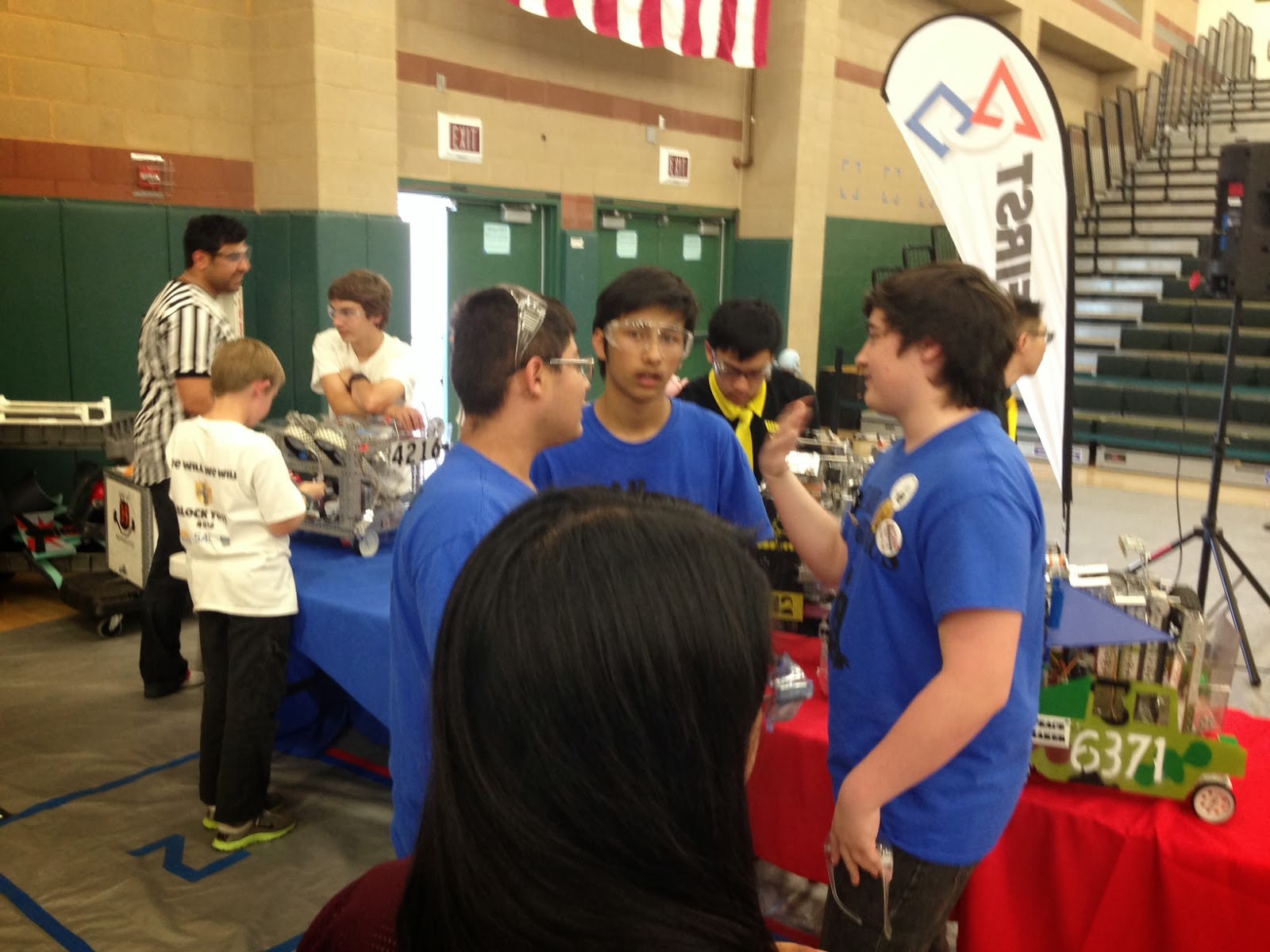
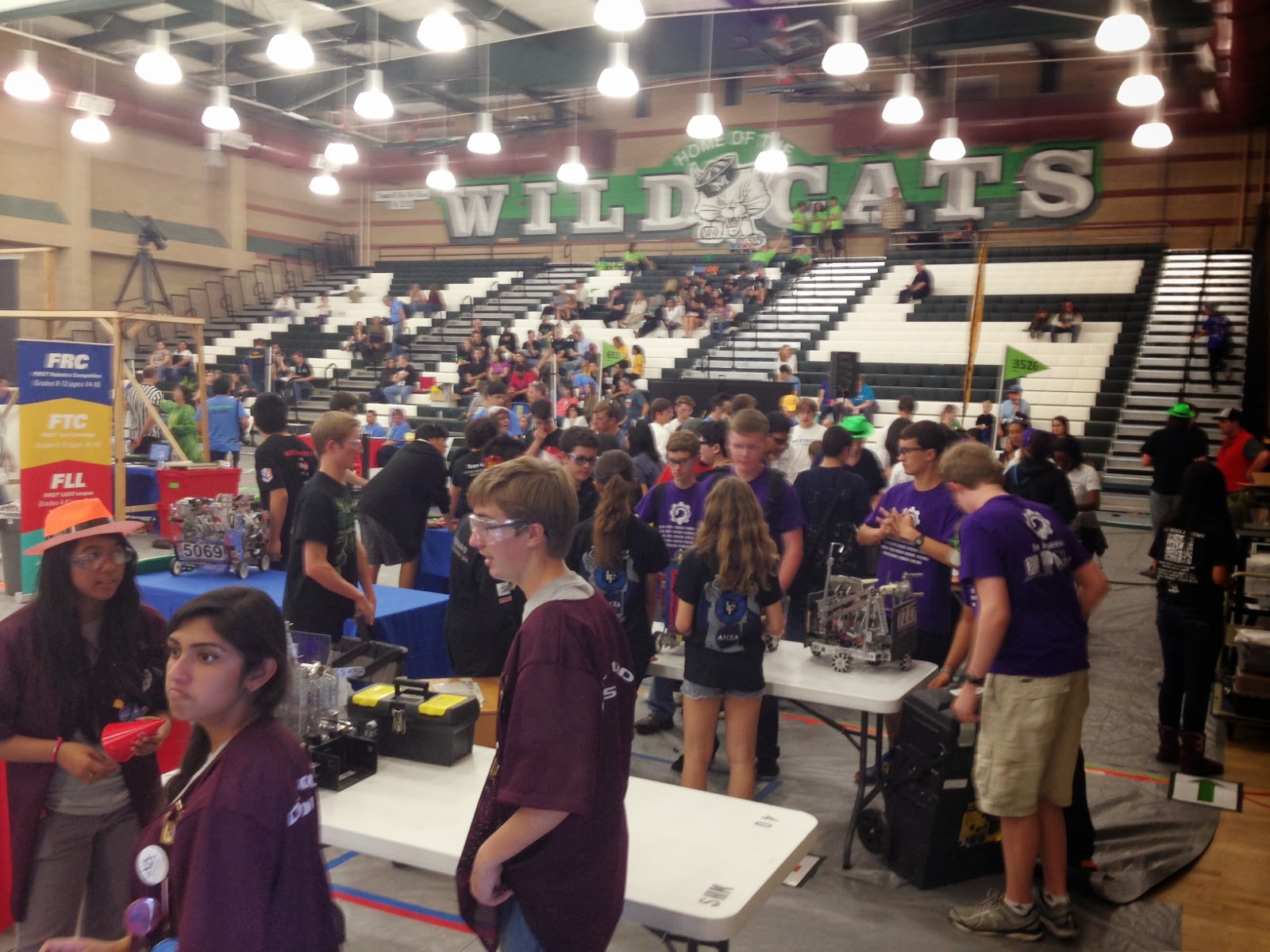
Saturday February 22, 2014 I went to volunteer for FIRST Robotics. I’m volunteering for an FTC event  for my independent component. Here are some of the photos that i took while i was working there and interacting with the staff and the participants of the event. 


Monday, February 24, 2014

Blog 16: Advisory Meeting #2

Content:


Just like you did for answer 1 and the objectives for Purther's textbook work for answer 2 post:

EQ: How best can an organization like FIRST keep students K-12 interested in STEM?

Answer 2: FIRST's progression of STEM programs spanning from K - 12th grade and beyond provide a constant outlet for kids to express their interest in STEM

1. Students usually lose interest in STEM topics in the 4th grade grade. FIRST provides a program known as Junior FIRST Lego League which provides kids with opportunities to engage in STEM activities between the ages of 6 through 9 and then the second in the progression of programs is the FIRST Lego League.

2. Two STEM programs from FIRST span from 7th - 12th grade and these critical programs help graduating high school students determine if they would like to acquire a degree in a STEM related area.

3. With 4 separate programs that build upon each other and use the skills that students learn in school to better help their understanding of engineering concepts as well as management; FIRST is able to maintain interest for their student population throughout their schooling years.

The research source (s) to support your details and answer

Paul, Richard. "Research Study of STEM Programs for Improved Retention, Progression, and Graduation (part 1)." WAMC. Northeast Public Radio, 1 Feb. 2008. Web. 21 Feb. 2014. <http://wamc.org/post/research-study-stem-programs-improved-retention-progression-and-graduation-part-1>.
What's FIRST? Perf. FIRST Robotics. Youtube.com. Official FIRST, 11 May 2011. Web. 20 Feb. 2014. <http://www.youtube.com/watch?v=u7k5IxsixO4>.
Fairweather, James. Linking Evidence and Promising Practices in Science, Technology, Engineering, and Mathematics (STEM) Undergraduate Education. N.p.: Michigan State Univeristy, n.d. Print
Concluding Sentence
FIRST provides a progression of programs that allows students to gain an interest in STEM. Their progression of programs begins at the Kindergarten level where they have 2 programs, then at the 7th - 12th grade level they have 2 more programs that are guides in undergraduate study selection and finally, all 4 programs work together in succession to create a complete program spanning all years of a students learning career.

Wednesday, February 12, 2014

Blog 15: independent Component 2 Approval

1.  Describe in detail what you plan to do for your 30 hours.


I'm going to be volunteering with the FIRST organization at several of their competition events. I will do 10 hours of work a day and i will experience what its like to be behind the scenes of the competitions. In detail, i will be volunteering as a "team queurer" which basically means i will be assigned some teams and i will be their assistant for the day reminding them of time and place. I will be helping set up a robotics competition and making sure that everything runs smoothly during each competition. I will do 3 different competitions between now and March. It should be a total of 30 hours of work comprised of 3, 10 hour sessions of straight work. I'm going to be exploring the 3 levels of STEM interaction between the competition hosts and the competitors. I'll be in direct contact with many STEM involved students and will have the ability to ask questions of them and speak to them while simultaneously being in contact with STEM operators that volunteer for free because they do believe in the ideal that is STEM and i will be able to question them and create a lot of evidence and research from that. Hopefully i'll make more connections so that i may expand my research as well.

2.  Discuss how or what you will do to meet the expectation of showing 30 hours of evidence.

I will have 3 sheets of service learning forms filled out with 10 hours each. I will also provide photos as well as physical evidence such as Tshirts or medals. I can also get a signed form stating that i did indeed complete the hours. 

3.  And explain how what you will be doing will help you explore your topic in more depth.
My independent component will put me in contact with STEM students and STEM supporters. It will allow me to gather the viewpoints of those students and the supporters of these types of programs which in turn will lead me to have connections to the program. I will also be able to talk and ask questions relating to my Essential question when i work with the supporters and i can also gain a viewpoint of the students involved in these types of programs.

Thursday, February 6, 2014

Blog 14: Independent Component 1

Blog 14: Independent Component 1

I, Brendan Trang, affirm that I completed my independent component which represents 30 hours of work.

  • (b) Cite your source regarding who or what article or book helped you complete the independent component
  • (d) Explanation of what you completed.    
I completed my independent component with a Science, Technology, Engineering, and Math program. The STEM program in question was FIRST Tech Challenge. I mentored with the Inland Empire Bronco robotics team. I was there when the team started and i attended meetings every Friday and Sunday and when it was necessary we met on other days or until late in the evening. As a team participating in the FIRST Tech Challenge, we raised money, organized a team, created a engineering notebook, built a robot that is specifically designed to perform certain tasks, and of course, we competed against other teams in many regional competitions. The task our robot was faced with was to score as many points as possible by interacting with 4 specific scoring elements; blocks, a pull-up bar, flags, and a ramp. I was part of the mechanical assembly team so i actually assembled the parts of the robot and brainstormed creative ideas with Bryan Posada, Carlos Cerillos, and several freshmen that are on the team. Our build and competition season has technically ended already. We didn't win anything but we did accomplish a lot and created a very nice robot. I have also prepared the team for the next season when all the current senior members will be gone.  I have been involved with the FIRST organization still; i volunteer for their competitions and i volunteered for one in November, and i will be volunteering for one in March.
  • INTERPRETIVE 
    Defend your work and explain how the significant parts of your component and how it demonstrates 30 hours of work.   Provide evidence (photos, transcript, art work, videos, etc) of the 30 hours of work.  
My topic focuses on involvement in Science, Technology, Engineering, and Math programs. The team i joined and helped was Team 7258, and the program they are part of is run by an organization called FIRST who is dedicated to running STEM programs. So i joined a STEM Program so that i could delve more into my topic and hopefully find answers to my topic and solidify my understanding of what i was saying. "Practice what you preach." I definitely dedicated more than 30 hours of my life to this team. I dedicated at least 6 hours a week sometimes more to the completion and preparation of my teams' robot for competition. Much like people dedicate time to sports after school and during matches, i dedicated my time to working and robotics. I spent my time tinkering with the robot and thinking of new ideas as well as volunteering. I was also one of the three seniors leading the team and along the way, i researched the FIRST organization and the previous programs it had and it helped me gauge a better understanding of the competition and what it wanted as well as helping me with my topic. Several significant parts of my component include; the FIRST Tech Challenge Competition, the Build Season, and the FIRST Organization. I was involved in all three of these and it really helped me understand the whole STEM fiasco and the ways we can fix it.

Evidence:
I took photos throughout the time as well as having my photo taken the entire time the team worked together. We also created several videos throughout the time to enter them into video contests hosted by the FIRST organization. 

This is a link to the gallery of my photographic evidence:
These are links to each individual photo set:


There are many more photos but i chose the best of the best and if there is any more need for evidence i have several videos below that were created by the team and I and if my presence in those videos is not enough evidence, i also have the link to the facebook group which the team created, also a link to our unfinished team website.


2013 in 90 Seconds


The Facebook Group:

Inland Empire Robotics

Team Website

and if you need any more proof that i did do 30 whole hours, i do have a notebook which i can bring in and show to you but its almost 200 pages long so i'm not going to scan it. Its the team notebook and it records everything w do together and with the robot.
  • APPLIED
    How did the component help you understand the foundation of your topic better?  Please include specific examples to illustrate how it helped. 
My topic is STEM Program Involvement. The way it helped me understand STEM program involvement was by allowing me to be involved in STEM programs. It allowed me to understand the practical applications of STEM. 
Specific examples, 
Foundation of my topic is Science, Technology, Engineering and Math, i worked with a robot and i had to learn engineering principles and learned about the technology as well as the math of buying these parts.
More specifically, our team was trying to decide how to best make use of all of our motors. We wanted to create a moving arm that pedestal'd up and then rotated at a hinge. We tried all combinations using one motor controller but we realized that 1 motor controller could not control 4 motors in a way that we wanted to so what we did was we had to buy another motor controller which was going to cost us around 90$ so we had to figure out a way to financially support that cost. We found a sponsor willing to sell give us some money as long as we put their logo on our shirt and robot.
The most important part of that experience was learning first hand about STEM and how important it was if we were to succeed in a technological world. I learned the basis of technology and engineering in this experience. It really helped me understand what people mean when they cry out "we need more students involved in STEM!" 
Grading Criteria 
  • Log on a digital spreadsheet 
  • Evidence of 30 hours of work 
  • LIA submitted to blog

Friday, January 31, 2014

Blog 13: Lesson 2 Reflection

Content:

1. Positive Statement

I thought my activities were well thought out and they had the entire class immersed. I also made sure to tie everything back to the EQ and my answer and i thought that worked out well.

2. Questions to Consider
       a.     What assessment would you give yourself on your Lesson 2 Presentation (self-assessment)?

       AE       P          AP       CR       NC

       b.     Explain why you deserve that grade using evidence from the Lesson 2 component contract.
I met all the P Requirements first of all. One of the things i think i did really well on was engaging the audience. My hook activity made everybody pull out their phones and send in messages that the whole class could see and it became a fun little game. For my activity, i also set everybody in groups and made them engage in the activity by creating a competition which enticed them to work together on creating balloon cars to race against one another. For the Audience Involvement criteria, i firmly believe that i was able to backup my EQ with my activity and the hook really caught their attention and held a bit of depth in their mind.

3. What worked for you in your Lesson 2?
I had a nice and cohesive presentation that tied in well with my activities. My presentation looked good and i made time. My activity was also very interactive and it made for a good followup to my EQ answer.
4.  (What didn't work) If you had a time machine, what would you have done differently to improve your Lesson 2?
I wasn't as rehearsed as i wish i had been and also the time for my activity was shorter than i anticipated. Some of the stuff i wanted to same didn't come out as eloquently as i had planned and thats mainly because i was just running through the whole presentation for the first time.

5. Finding Value
What do you think your answer #2 is going to be?  
Answer 2 is going to involve the multi-level STEM program progression, or basically how the multiple levels of STEM programs provides good interest in STEM.

Monday, January 27, 2014

January Extra Blog Post

So in january, we have been invited to showcase our robot in a FIRST Robotics Competition. Our robot was chosen by Richard Sisk to represent his team in a younger robotics division. I also had an interview with Richard recently that helped me a lot with my EQ because of his insight into the FIRST program and his ideals as a mentor. His team was deep in the build season and he barely had time to be interviewed but it was evident that the team was busy and bustling and ready to go.
The interview proved to be very useful and supplied me with a lot of the information that i will be able to use for my answer.

Our competition season is over now so we cant compete anymore really. Although we have been trying to apply to another competition up in sacramento, our hopes of really going there are slim to none due to cost issues. At this point, we dont really know where to go with our robot. We have started applying for grants for money so that we may buy more parts next year. We also got invited to showcase our robot as a new rookie team. I hope to continue to volunteer with FIRST and i will be attending an event on february 2nd which i will write about in the february blog. 

Not much else is happening but here are some photos of the team working together and planning. I took these photos at a recent meeting and most of it consisted of planning for the future. For now, we just look forward and hope for the best.


These photos were taken before the competition day on the 11th. I wasn't able to go and take photos of the competition because i went on the hike trip but i was there with the team helping them prepare. They didn't do too well from what i heard though. So much for all their preparation.

Tuesday, January 14, 2014

Blog 12: Third Interview Questions

Content:

Post 10 open-ended questions for approval you want to ask an expert in the field of your senior project.  The first question should be your essential question and the other nine must be about the foundation of your essential question or help you answer your essential question.

How best can FIRST keep students involved in STEM?

What sort of outreach programs do you guys do and who benefits most from it?

What got you involved in FTC and how has it changed you?

What is the most important thing that the kids you mentor take away from this experience?

What is the importance of STEM in our world today and why do you think we should keep students involved in it?

How well do you think programs like FRC/FTC/FLL keep students involved in STEM and why is that?

FTC/FRC/FLL aren't the only programs out there, what do you think it is about this program that makes it different? And none of that Gracious Professionalism/ coopertition stuff, give me the real low down.

As a mentor, whats in it for you that keeps you coming back for more?

What kind qualifications did you need or did you have to be a part of this and how or why did your team start?

What is it about the spirit of competition that just gets kids and students alike so riled up about these robots?